High-throughput DFT
descriptors
Normally, DFT-level descriptor calculation requires coordinating numerous packages, debugging academic code, and weeks on HPC clusters. We automated this process, reduced the time to hours, and created a simple interface for harnessing it.
Platform benchmarks
Faster than traditional DFT
GPU acceleration + neural network potentials vs. CPU-only HPC cluster workflows.
Physics-based descriptors
3D-geometry and quantum-chemistry computed descriptors. Orbital energies, charges, steric parameters, and more.
Library featurization
Full molecular library DFT featurization that took months on HPC clusters.
How It Works
From flat molecules to quantum descriptors
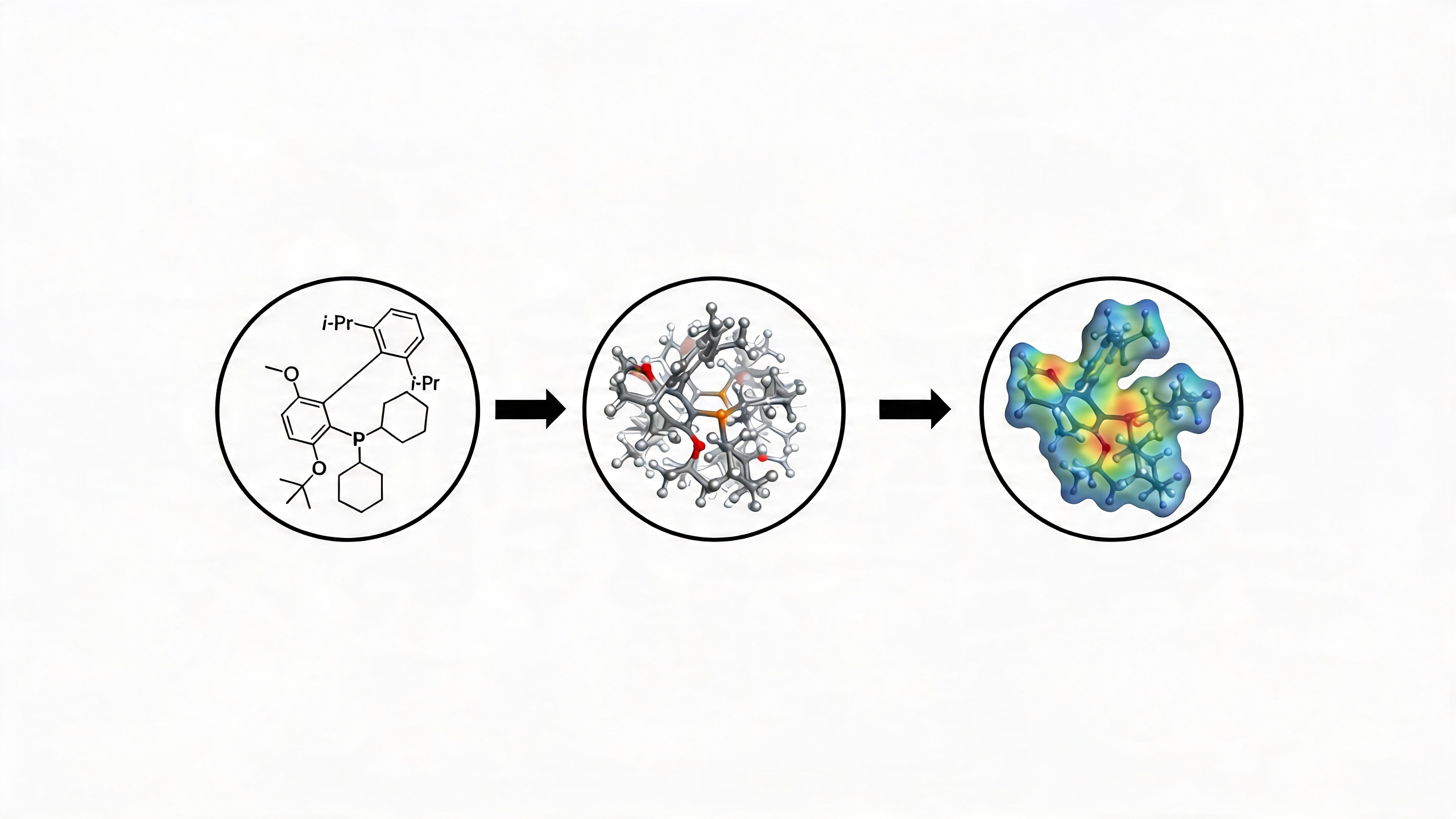
Our structure-agnostic pipeline transforms 2D molecular representations into DFT-level electronic properties, fully automated, no HPC cluster required.
Diverse Structure Input Formats
Start from SMILES strings, CDXML, or 3D coordinates. Upload MOL2, XYZ, CSV, or SDF files — the pipeline handles everything from flat molecular representations to full 3D geometries.
3D Geometry Optimization
Generate conformer ensembles using CREST or GPU-accelerated RDKit/nvMolKit ETKDG. Further optimize geometries using neural network potentials like Meta's UMA to access DFT-level molecular geometries.
Electronic Structure & Descriptors
GPU-accelerated DFT followed by automated extraction of descriptors provides you with an organized dataset of whole-molecule, atom-level, and bond-level descriptors ready for modeling.
No queue management
Submit thousands of molecules and walk away. No SLURM scripts, no HPC allocation requests, no babysitting jobs.
vs. weeks configuring HPC clusters
Automatic error recovery
Failed geometries retry with alternate methods. Problematic molecules get flagged, not silently dropped.
vs. manual debugging per molecule
Exported descriptors are ready for machine learning
Download as CSV. Column-level descriptor selection before export.
vs. parsing custom output files
Reproducible by default
Every job logs its full configuration — basis set, solvent model, conformer method, software versions.
vs. undocumented lab scripts
See it in action
From upload to ML-ready in three steps
A fully automated pipeline accessible through a simple interface — no HPC cluster required.
Upload
Drop in your molecular library
Upload SMILES, SDF, CDXML, MOL2, or XYZ files. The molecule editor validates structures and flags issues before compute begins.
Configure
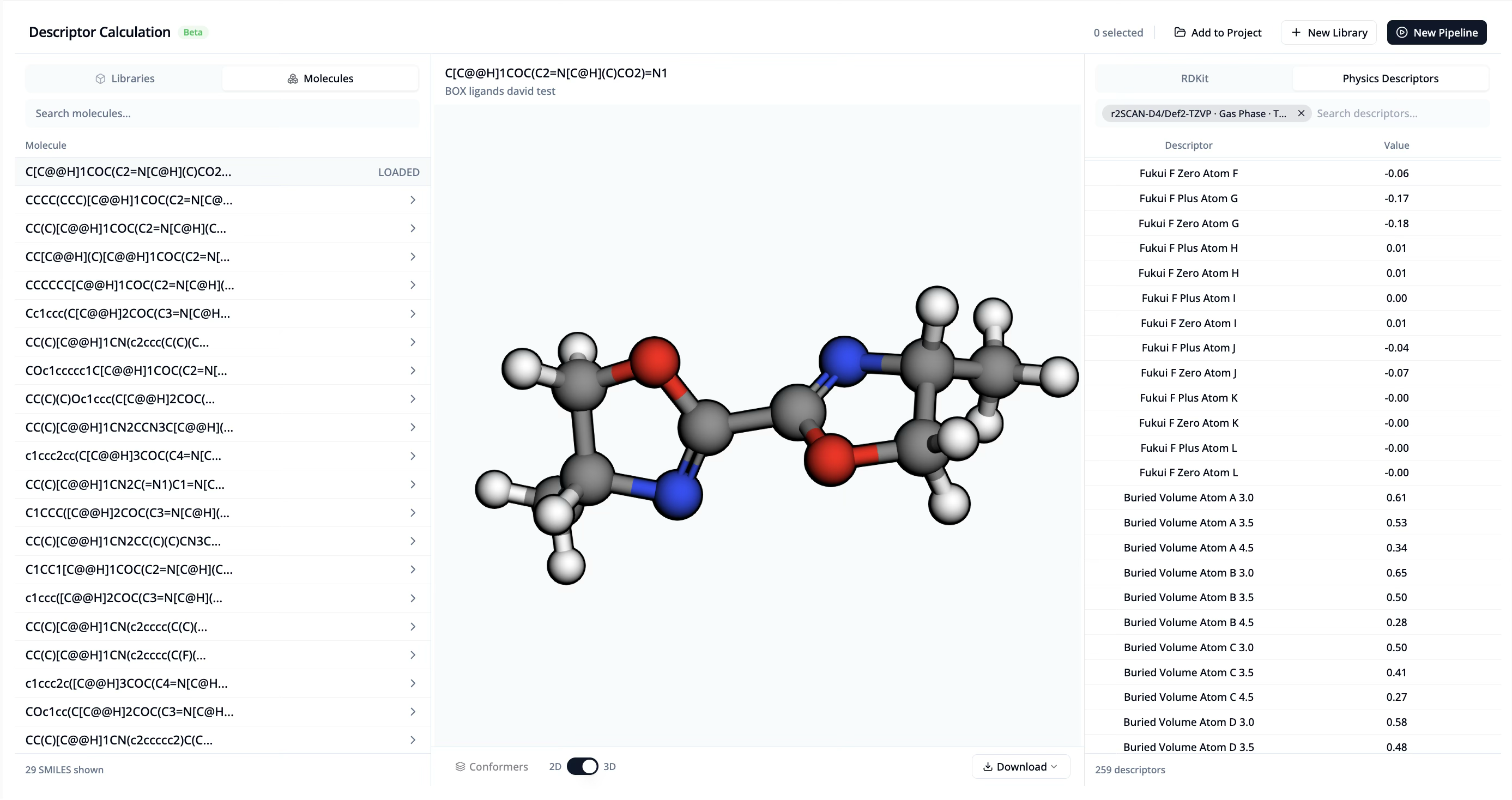
Pick your functional, basis set, and solvent
Four tiers of theory. Choose your accuracy-speed tradeoff, select solvation models, and configure output descriptors.
Results
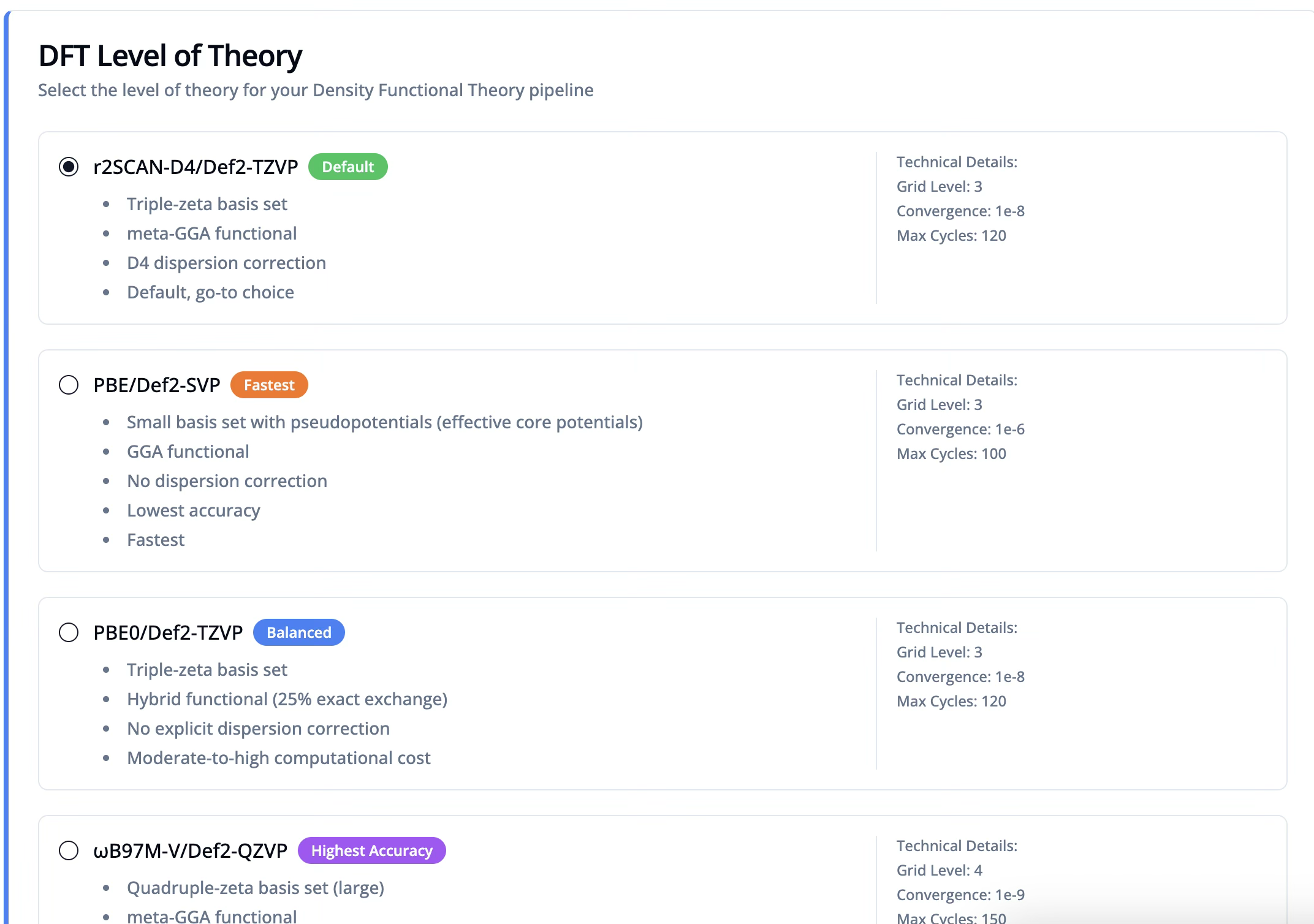
ML-ready descriptors
Browse bond lengths, Sterimol parameters, Fukui indices, buried volumes, and dozens more — all computed per molecule and ready to export as CSV.
Applications
Physics-informed features for every domain
Drug Discovery
Generate QSAR-ready descriptors for hit-to-lead optimization. Predict pIC50, solubility, and ADMET properties with physics-informed features that capture electronic structure beyond fingerprints.
Catalyst Design
Compute Sterimol parameters, buried volumes, and electronic properties for ligand optimization in asymmetric catalysis, cross-coupling, and other reaction classes.
Materials Science
Characterize polymer building blocks and functional materials with atom-level electronic descriptors at DFT accuracy. Model structure-property relationships for novel material design.
Atom Label Editor
Label atoms for bond- and atom-level descriptors
Upload CDXML molecules with bond and atom labels, or upload SMILES or 3D structures and label atoms in browser with our labeling tool. Our common-substructure algorithm identifies shared scaffolds across your library and auto-assigns consistent labels to atoms of interest. Edit any label to match your naming convention and the same labels propagate to every matching molecule.
Atom 19 · N (C, C)
Atom 9 · N (C, C)
Atom 6 · O (C, C)
Atom 18 · O (C, C)
Atom 4 · C (O, C, N)
Atom 5 · C (C, N, O)
Atom 7 · C (C, N, H)
Atom 10 · C (N, C, C, H)
Automatic MCS detection
Finds the maximum common substructure across your library — no manual alignment needed.
Consistent labeling
Deterministic atom ordering guarantees the same label set regardless of upload order.
Bond & atom descriptors
Labels enable per-bond and per-atom descriptor extraction from DFT or GFN2-xTB calculations.
Ready to compute descriptors?
Upload your molecular library and get ML-ready DFT descriptors in hours, not weeks.