AI-guided process
optimization
Reduce experiments by 90% with Bayesian optimization. Our engine learns from each round, navigating high-dimensional parameter spaces to converge on optimal conditions Faster than DOE or traditional approaches.
Platform benchmarks
Fewer experiments
Reduction in experiments required compared to traditional DOE and one-factor-at-a-time approaches.
Faster discovery
Faster condition discovery versus grid search or random screening on benchmark reaction datasets.
Time to first result
From uploading your first batch of experiments to receiving AI-guided recommendations.
Case Study 01
Direct C–H arylation
With 1728 possible reaction condition combinations, Chemetrian optimization software guides which experiments to perform to achieve >95% yield within 17 experiments, and >98% yield in 22 experiments.
combinations
Temperature
Concentration
Solvents
Ligands
Bases
of combinations tested
expts to >95% yield
expts to >98% yield
Chemetrian Bayesian Optimization demonstrated on B. J. Shields et al., Nature 2021, 590, 89.
Why Bayesian Optimization?
How BO compares to Design of Experiments
Bayesian optimization learns from each experiment and intelligently suggests the next best experiment to run. Achieves equal or superior outcomes with dramatically fewer trials.
Optimization speed vs. exhaustive experimentation
Finds optimal conditions with the fewest experiments. Decrease experiments by 50–90% compared to traditional screening.
Runs a full pre-defined matrix. Valuable when comprehensive documentation is required, such as regulatory filings or process validation.
Adaptive vs. pre-specified
Updates its model after every batch and redirects experiments in real time. Each round learns from the last, converging faster.
Requires the full experimental design to be locked in before a single reaction is run. No mid-course corrections.
Native handling of categorical variables
Encodes all variable types, numerical and categorical (base, ligand, solvent), directly into the ML model in a single optimization.
Designed for continuous variables. Categorical variables must be screened independently since they can't be included in the model.
Case Study 02
Suzuki–Miyaura coupling
With 924 possible reaction condition combinations, Chemetrian optimization software guides which experiments to perform to achieve >95% yield within 17 experiments, and >98% yield in 30 experiments.
combinations
B(X)ₙ
Ligands
Bases
Solvents
of combinations tested
expts to >95% yield
expts to >98% yield
Chemetrian Bayesian Optimization demonstrated on Perera et al., Science 2018, 359, 429.
Built for interpretability
See exactly why the model made each recommendation
Every optimization run surfaces the visualizations you need to trust and communicate your results. From feature analysis to parity plots to 3D response surfaces.
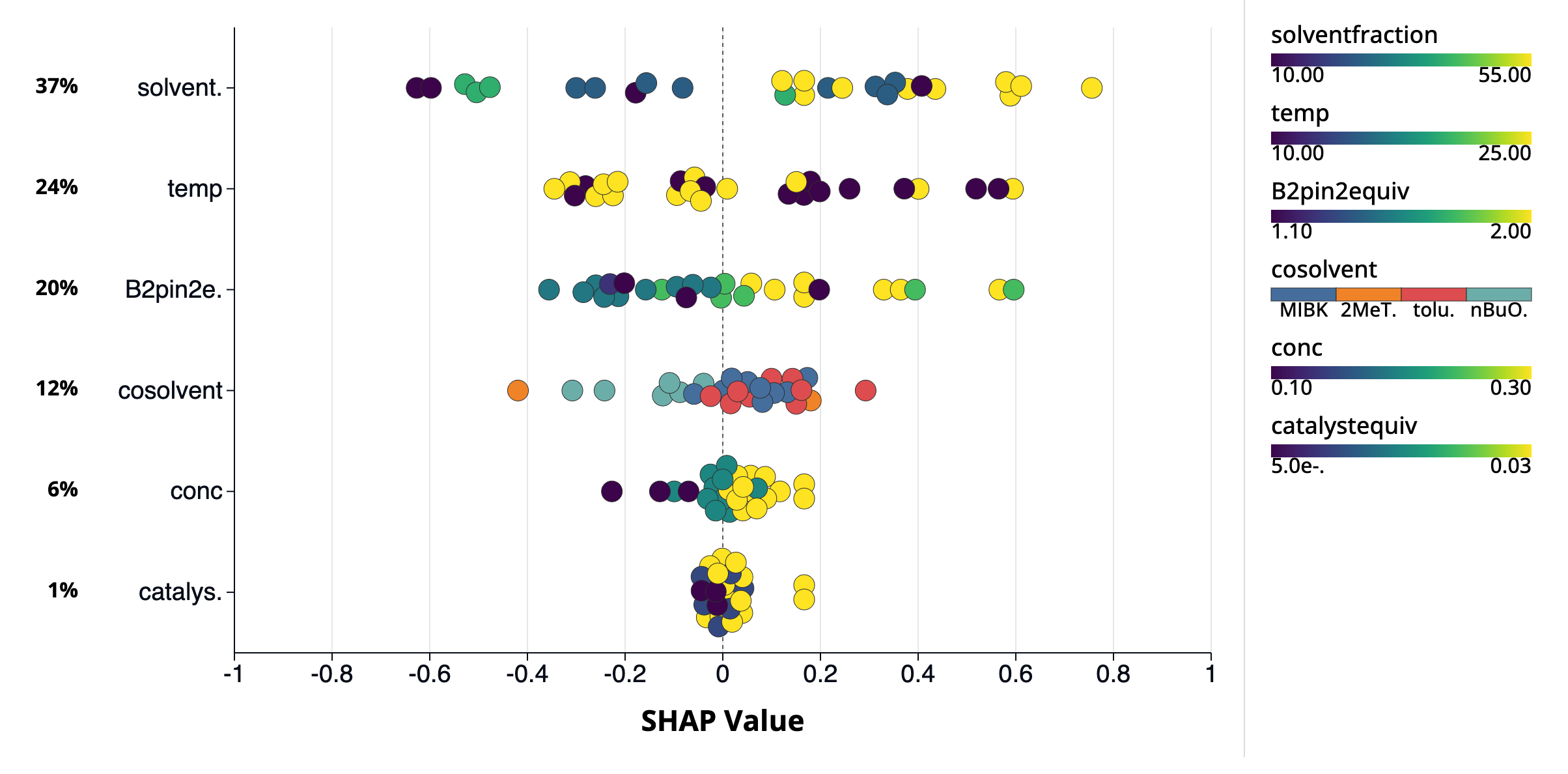
SHAP Analysis
Understand which features drive your model predictions with interactive SHAP value beeswarm plots.
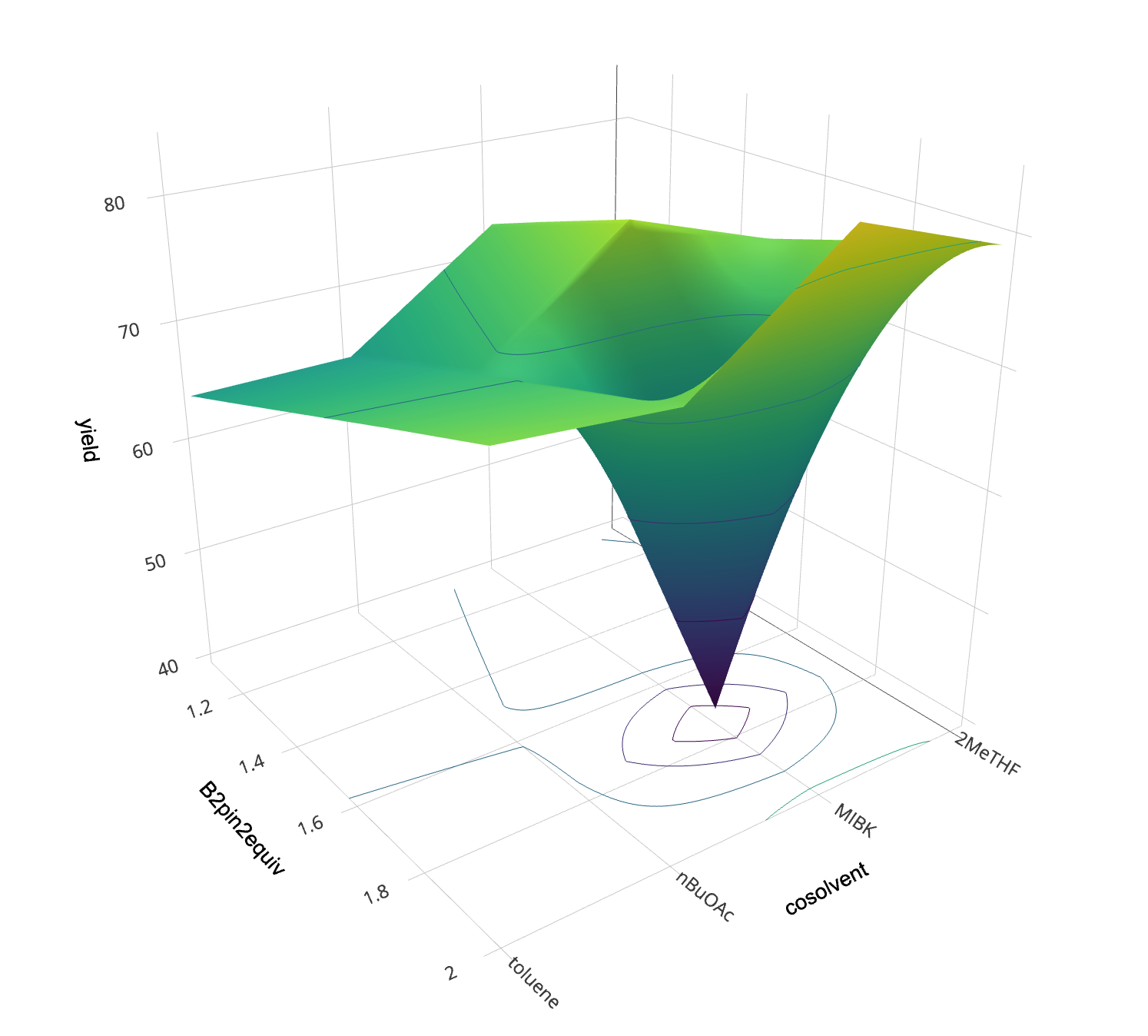
Multi-Dimensional Optimization
AI models navigate high-dimensional parameter spaces, learning from each experiment to converge on optimal conditions faster.
Surrogate Model Visualization
Visualize the learned objective function per feature. See the mean prediction with confidence bands and where the model suggests exploring next.
Process optimization
Agentic AI literature suggestions
Agentic literature search is an AI-driven approach that uses large language models (LLMs) combined with retrieval-augmented generation (RAG) to analyze and synthesize information from millions of chemistry publications. Instead of manually reviewing papers, the system autonomously searches the literature based on key aspects of a reaction campaign such as starting materials, target structures or reaction class and identifies experimentally validated conditions.
The model iteratively refines its search, evaluates supporting evidence across sources, and proposes promising reaction conditions while citing the underlying literature and explaining why each recommendation is a strong candidate. This enables chemists to rapidly surface actionable insights from a database of chemical knowledge translating literature into informed reaction conditions and parameter spaces for optimization.
Optimized values for your existing reaction conditions
Ready to optimize your reactions?
Upload your first batch of experiments and let the Bayesian engine guide you to optimal conditions.