Agentic reaction
recommendation
Save hours of literature searching and analysis. Our agentic AI searches millions of chemistry publications, synthesizes evidence across sources, and proposes promising reaction conditions — with citations and rationale for every recommendation.
Why agentic literature search?
to minutes
Reduce hours of manual literature searching to minutes of automated, evidence-based analysis.
of publications
The agent searches across a database of chemistry literature to find experimentally validated conditions.
recommendations
Every proposed condition includes citations and rationale explaining why it is a strong candidate.
See It In Action
From reaction inputs to literature-backed conditions
Enter your starting materials, target product, and reaction type — the agent searches millions of publications and returns ranked, cited recommendations.
Alternative Approaches
If Pd-catalyzed Suzuki-Miyaura remains problematic (e.g., persistent protodeboronation or strong Pd poisoning by the aminopyrimidine-like electrophile), alternatives include: (i) switching boron class (e.g., potassium organotrifluoroborates); (ii) micellar conditions with Kolliphor EL for aerobic operation at RT; or (iii) Negishi/Stille manifolds when heteroaryl boron instability dominates.
Analysis
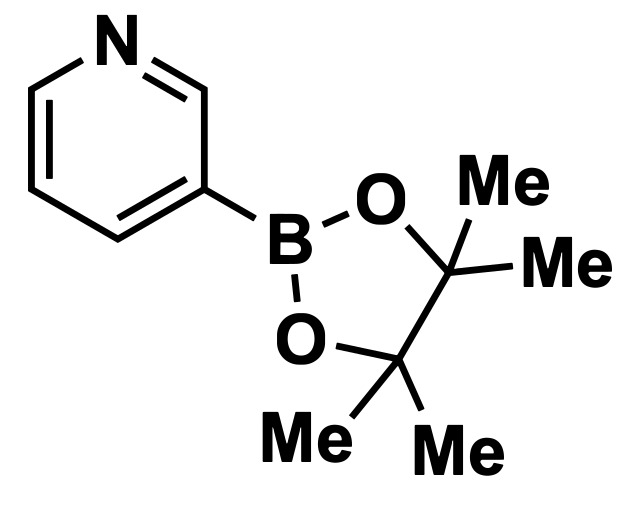
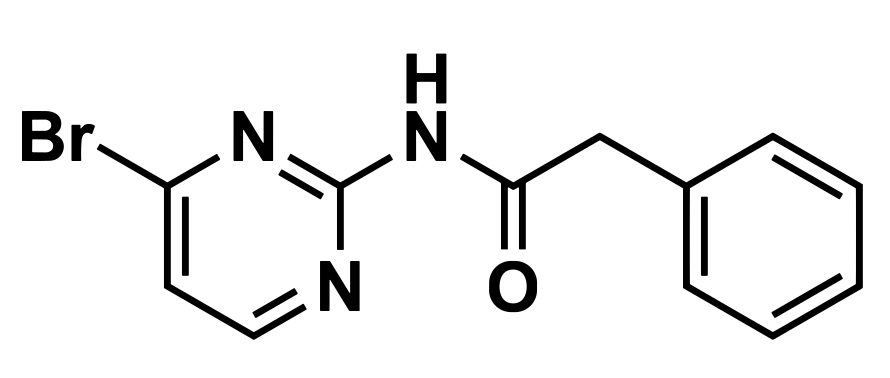
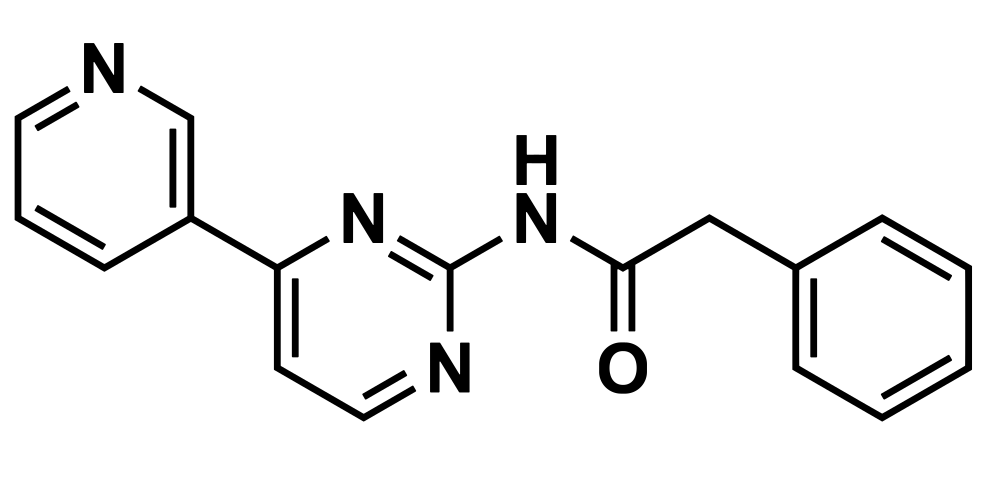
This transformation is a Suzuki–Miyaura cross-coupling between a heteroaryl boronate ester (SMILES: CC(O1)(C)C(C)(C)OB1C2=CC=CN=C2; consistent with a neopentyl-glycol boronate on a pyridyl ring) and a brominated, N-rich aza-heteroaryl electrophile bearing an amide side chain (SMILES: BrC1=CC=NC(NC(CC2=CC=CC=C2)=O)=N1), to form an aza-heteroaryl–pyridyl biaryl (target: O=C(CC1=CC=CC=C1)NC2=NC(C3=CN=CC=C3)=CC=N2). Key mechanistic/operational challenges are (i) catalyst inhibition/poisoning from multiple ring nitrogens on both coupling partners, (ii) protodeboronation and/or oxidative homocoupling of pyridyl boron reagents under aqueous/basic/high-temperature conditions, and (iii) competing hydrodehalogenation (debromination) of the heteroaryl bromide under strongly reducing/basic conditions. For this reaction class, the most relevant optimization metrics are: isolated yield of the desired coupled product; conversion of the heteroaryl bromide; impurity profile (especially debrominated electrophile, homocoupled biaryl, and protodeboronated heteroaryl); robustness to air/moisture (operational simplicity); and palladium residuals/workup burden if process development is anticipated.
Recommended Conditions (4)
| Base | Solvent | Catalyst | Additive | Atmosphere | Water |
|---|---|---|---|---|---|
| TMSOK (1.2 equiv) | DME, anhydrous | Pd-CataCXium A-G3 (3 mol%) | B(OMe)₃ (3.0 equiv) | Inert | Rigorously excluded |
Expected Outcome: ~70–80% isolated yield; large rate boost vs no B(OMe)₃ (e.g., 81% vs 13% at 60 min in a 3-pyridyl model)
- [1] Kassel et al., "Heteroaryl-heteroaryl Suzuki-Miyaura anhydrous coupling," 2021, pp. 5–6
- [2] Parmentier et al., "A general kilogram-scale protocol," 2020, pp. 2–3
- [3] Jedinák et al., "4-Arylation of N-acylamino heterocycles," 2016, pp. 2–5
- [4] Martin, R.; Buchwald, S. L., Acc. Chem. Res., 2008, 41, 1461–1473
- [5] Lennox et al., Chem. Soc. Rev., 2014 (boron reagent stability)
- [6] Sarmah et al., "Alcoholic solvent-assisted ligand-free," 2015, pp. 2–3
- [7] Mattiello et al., "Suzuki-Miyaura micellar cross-coupling," Org. Lett., 2017, pp. 1–2
- [8] Reizman, B. J. et al., React. Chem. Eng., 2016, 1, 658–666
Agentic literature search
An AI-driven agent uses LLMs and retrieval-augmented generation to autonomously search millions of chemistry publications — surfacing experimentally validated conditions in minutes, not hours.
Literature-backed decisions
Every recommendation cites the underlying literature and explains why each condition is a strong candidate, empowering scientists to make informed decisions with full provenance.
From scouting to optimization
Applicable at any stage, from identifying promising starting conditions to intelligently scoping parameter spaces for a full optimization campaign in the process optimization tool.
Iterative refinement
The model iteratively refines its search, evaluates supporting evidence across sources, and synthesizes insights from a database of chemical knowledge into actionable reaction conditions.
From literature to lab-ready conditions
The agent autonomously searches, synthesizes, and ranks experimentally validated conditions — translating a database of chemical knowledge into actionable insights.
3 of 12 conditions found
Intelligent Literature Mining
The agent searches based on starting materials, target structures, or reaction class and identifies experimentally validated conditions across thousands of publications.
See how it worksRanked by citation count & yield data
Evidence Synthesis & Ranking
Cross-references findings across multiple sources, evaluates supporting evidence, and ranks candidate conditions by relevance, yield, and experimental reliability.
Ready for optimization →
Parameter Space Design
Translates literature insights into structured parameter spaces — catalysts, solvents, temperatures, and equivalents — ready for process optimization campaigns.
Design a campaignApplications
Applicable at any stage of your campaign
Reaction condition scouting
Rapidly identify promising starting conditions for new reactions, catalysts, solvents, bases, and temperatures backed by published experimental data.
Process optimization
Design informed parameter spaces for optimization campaigns by grounding ranges and categorical choices in literature precedent.
Cross-coupling & beyond
Applicable across reaction classes, from Suzuki-Miyaura and Buchwald-Hartwig couplings to amide formations, reductions, and other transformations.
Ready to find better conditions?
Let our AI agent search the literature so you can spend time at the bench, not behind a screen.