Retrosynthesis for
complex targets
Scout routes for your molecules before experimenting. Surface known routes, use AI to generate new routes, and rank strategies side by side.
Novel routes, grounded in literature
of documents read
Our system searches millions of chemistry papers and patents to identify the known routes to your target and the patents covering them.
chemistry built in
Routes are steered toward safer solvents, milder conditions, and cleaner reagents, so what comes back is something a modern process group would actually run.
sourcing & costing
Every starting material is checked for availability against suppliers worldwide and priced into a materials cost per gram of target.
See it in action
A real route to bexobrutideg
The engine generated novel disconnections for this BTK degrader, surfaced the known routes and patents covering it from millions of documents, gave every step a literature-backed design space, and priced the materials against suppliers worldwide.
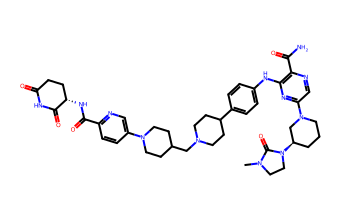
7-step convergent synthesis
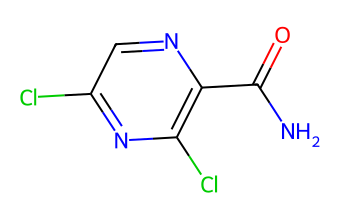
- 3,5-dichloropyrazine-2-carboxamide(reagent)· 1.0 eq
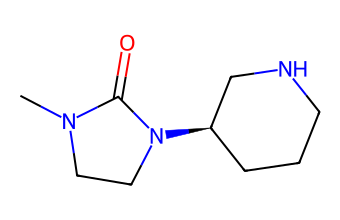
- 1-methyl-3-[(3R)-piperidin-3-yl]imidazolidin-2-one(reagent)· 1.05-1.2 eq
- N,N-diisopropylethylamine(base)· 2.5-3.0 eq
- dimethyl sulfoxide(solvent)· —
DMSO (or NMP/MeCN), 60–80 °C, 4–16 h, N2; selective mono-substitution at C-5
0.2–0.4 M in the dichloropyrazine
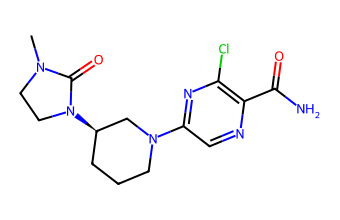
Charge 3,5‑dichloropyrazine‑2‑carboxamide (1.0 eq, limiting) and 1‑methyl‑3‑[(3R)‑piperidin‑3‑yl]imidazolidin‑2‑one (1.05–1.2 eq, free base or its HCl salt) into anhydrous DMSO (or NMP/MeCN), add DIPEA (2.5–3.0 eq) and stir the mixture under nitrogen at 60–80 °C for 4–16 h, monitoring by LC‑MS for consumption of the dichloride (mono‑SNAr occurs selectively at C‑5, the position remote from the carboxamide, leaving the C‑3 chloride intact for the subsequent Buchwald/SNAr aniline coupling). Cool to room temperature, drown into water/brine, collect the precipitated solid by filtration or extract with EtOAc/DCM‑iPrOH, dry (Na2SO4) and concentrate. Purify by silica chromatography (0–10% MeOH/DCM) or reverse‑phase prep‑HPLC/trituration to give the 5‑amino‑3‑chloropyrazine‑2‑carboxamide as an off‑white solid.
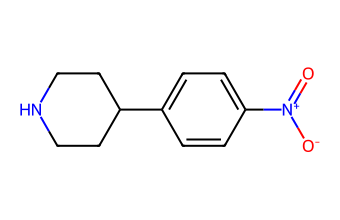
- 4-(4-nitrophenyl)piperidine(reagent)· 1.0 eq
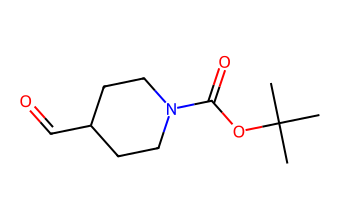
- tert-butyl 4-formylpiperidine-1-carboxylate(reagent)· 1.2 eq
- sodium triacetoxyborohydride(reagent)· 1.5-2.0 eq
- acetic acid(reagent)· 0.1-1.0 eq
- N,N-diisopropylethylamine(base)· 1.0-2.0 eq (only if amine HCl salt used)
- 1,2-dichloroethane(solvent)· solvent
1,2-Dichloroethane (or DCM), 0 °C → rt, 12–18 h, N2, then aq. NaHCO3 quench
0.1–0.2 M in the nitrophenylpiperidine
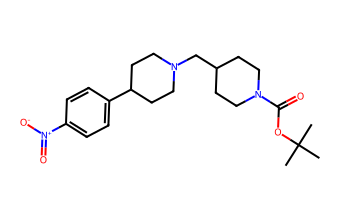
To a solution of 4-(4-nitrophenyl)piperidine (1.0 eq, often used as the free base or liberated in situ from its HCl salt with Et3N/DIPEA) and tert-butyl 4-formylpiperidine-1-carboxylate (1.1–1.3 eq) in 1,2-dichloroethane (or DCM/THF) under nitrogen is added glacial acetic acid (0.1–1.0 eq), and the mixture is stirred at room temperature for 30–60 min to allow iminium/hemiaminal formation. Sodium triacetoxyborohydride (1.5–2.0 eq) is then added portionwise at 0 °C–rt and the mixture is stirred at room temperature for 12–18 h. The reaction is quenched with saturated aqueous NaHCO3, extracted with DCM (or EtOAc), the combined organics washed with brine, dried over Na2SO4, concentrated, and the crude bis-piperidine purified by silica chromatography (0–10% MeOH/DCM with 1% NH4OH, or EtOAc/heptane) to give the Boc-protected product, typically in 70–90% yield.
- Palladium on carbon (10 wt%)(catalyst)· 0.05-0.1 eq Pd (10-20 wt% loading)
- Hydrogen(reagent)· excess (1 atm balloon)
- Methanol(solvent)· solvent
- Ethyl acetate(solvent)· co-solvent
MeOH/EtOAc (1:1), H2 (1 atm, balloon), rt, 3-16 h, then Celite filtration
0.05-0.15 M (typically ~0.1 M)
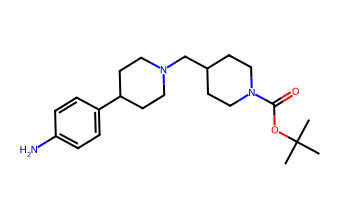
Dissolve the nitroarene (1.0 eq) in MeOH/EtOAc (or THF/MeOH ~1:1) to give a ca. 0.1 M solution, add 10% Pd/C (10–20 wt %, 50% water-wet) under a nitrogen blanket, then purge the vessel and stir vigorously under a hydrogen atmosphere (balloon or 1–4 bar Parr) at room temperature for 3–16 h until TLC/LCMS shows full conversion of the nitro compound to the aniline. Filter the mixture through a pad of Celite, rinsing with MeOH/DCM, and concentrate under reduced pressure; the crude aniline is usually of sufficient purity to carry forward, or can be purified by silica chromatography (0–10% MeOH/DCM with 1% NH4OH). If catalytic hydrogenation is problematic on scale, an equivalent result is obtained with Fe powder (5 eq)/NH4Cl (5 eq) in EtOH–H2O (4:1) at 70–80 °C for 1–2 h.
- Pd2(dba)3(catalyst)· 0.05 eq
- Xantphos(ligand)· 0.10 eq
- Cesium carbonate(base)· 2.0 eq
- 1,4-Dioxane(solvent)· —
1,4-Dioxane (degassed), 100 °C, 12–16 h, N2 (sealed vial; or microwave 120 °C, 1–2 h)
0.08–0.15 M in the chloropyrazine (limiting reagent)
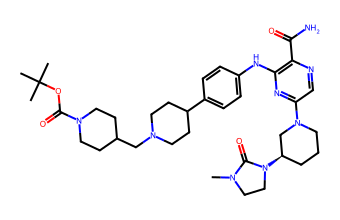
Combine 3-chloro-5-[(3R)-3-(4-methyl-3-oxopiperazin-1-yl)piperidin-1-yl]pyrazine-2-carboxamide (1.0 eq), the tert-butyl 4-{[4-(4-aminophenyl)piperidin-1-yl]methyl}piperidine-1-carboxylate aniline (1.1–1.2 eq), Cs2CO3 (2.0–2.5 eq), Pd2(dba)3 (5 mol %) and Xantphos (10 mol %) in degassed 1,4-dioxane in a sealed vial, then sparge with N2 for 5–10 min. Heat the mixture at 95–105 °C (oil bath or microwave at 120 °C for 1–2 h) for 12–16 h, monitoring by LC-MS for consumption of the chloropyrazine. Cool, dilute with EtOAc/water (or filter through Celite), extract, dry over Na2SO4, concentrate, and purify by silica chromatography (0–10% MeOH/DCM) or reverse-phase prep-HPLC to give the Boc-protected coupled aniline. (An acid-promoted SNAr — the aniline, 1.05 eq, with cat. p-TsOH·H2O or 4 M HCl/dioxane in NMP/iPrOH at 100–120 °C — is a viable Pd-free alternative given the carboxamide-activated 3-chloropyrazine.)
- Hydrogen chloride (4 M in 1,4-dioxane)(reagent)· 10-20 eq
- 1,4-Dioxane(solvent)· —
- Dichloromethane(solvent)· —
DCM/1,4-dioxane, 0 °C to rt, 1-4 h, N2 (or air); concentrate and triturate with Et2O
0.05-0.2 M (typically ~0.1 M in substrate)
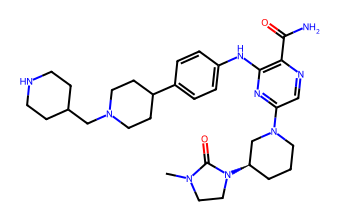
The Boc-protected bis-piperidine intermediate was dissolved in dichloromethane (or 1,4-dioxane) and treated with 4 M HCl in 1,4-dioxane (10–20 equiv) at 0 °C, then stirred at room temperature for 1–4 h until LC-MS showed complete consumption of the carbamate. The volatiles were removed under reduced pressure and the residue was triturated with diethyl ether (or MTBE) and dried under vacuum to give the secondary amine as the hydrochloride salt, which was used directly in the subsequent reductive amination/SNAr step without further purification. If the free base was required, the residue was partitioned between DCM/MeOH (9:1) and saturated aqueous NaHCO3 (or passed through an SCX-2 cartridge eluting with 2 M NH3/MeOH).
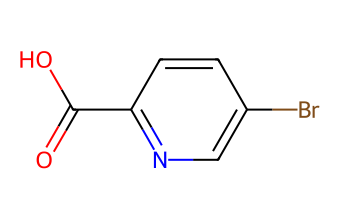
- 5-Bromopyridine-2-carboxylic acid(reagent)· 1.0 eq
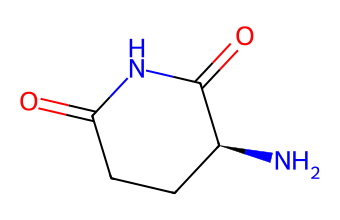
- 3-Aminopiperidine-2,6-dione hydrochloride(reagent)· 1.1 eq
- HATU(coupling reagent)· 1.2 eq
- N,N-Diisopropylethylamine(base)· 3.0 eq
- N,N-Dimethylformamide(solvent)· solvent
DMF, 0 °C → rt, 4–16 h, N₂
0.1–0.2 M (in the limiting acid)
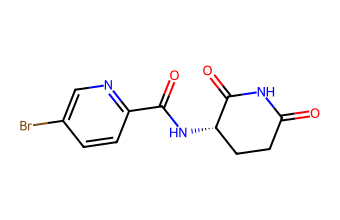
5-Bromopyridine-2-carboxylic acid (1.0 eq) is dissolved in anhydrous DMF (~0.15 M) and treated with HATU (1.1–1.3 eq) and DIPEA (3.0–4.0 eq) at 0 °C, and the mixture is stirred 10–20 min to pre-activate the acid. 3-Aminopiperidine-2,6-dione hydrochloride (1.05–1.2 eq) is then added in one portion and the reaction is allowed to warm to room temperature and stirred 4–16 h under nitrogen, with monitoring by LC–MS. The mixture is diluted with water (or poured onto ice-water/brine), and the precipitated amide is collected by filtration, or the product is extracted into EtOAc/DCM, washed with saturated NaHCO₃, water and brine, dried over Na₂SO₄, concentrated and purified by silica chromatography (0–8% MeOH/DCM) or trituration from MeOH/Et₂O to give the coupled glutarimide amide. Reaction temperature is kept mild and base stoichiometry moderate to limit epimerisation of the acid-sensitive glutarimide stereocentre.
- RuPhos Pd G3(catalyst)· 0.1 eq
- RuPhos(ligand)· 0.1 eq
- Cesium carbonate(base)· 3.0 eq
- 1,4-Dioxane(solvent)· —
- 5-Bromo-N-(2,6-dioxopiperidin-3-yl)pyridine-2-carboxamide(reagent)· 1.2 eq
1,4-dioxane (degassed), 90–100 °C, 3–16 h, N₂ atmosphere, sealed vial
0.05–0.1 M (in the limiting piperidine)
Combine the secondary piperidine (1.0 equiv, limiting) and 5‑bromo‑N‑(2,6‑dioxopiperidin‑3‑yl)pyridine‑2‑carboxamide (1.2–1.5 equiv) in anhydrous 1,4‑dioxane (or dioxane/t‑BuOH 4:1) in an oven‑dried vial, add Cs₂CO₃ (2.5–3.0 equiv), then sparge the mixture with N₂ for 5–10 min before adding RuPhos Pd G3 (0.10 equiv) and RuPhos (0.10 equiv). Seal and heat at 90–100 °C with stirring for 3–16 h (monitor by LC‑MS), then cool, dilute with DMSO/MeOH, filter through Celite and purify directly by reverse‑phase prep‑HPLC (0.1% formic acid or 10 mM NH₄HCO₃ modifier) to give the C–N coupled product, typically in 20–45% yield. Because the glutarimide C‑3 stereocentre epimerises under prolonged basic heating, keep the reaction time as short as conversion allows and neutralise/quench promptly; alternatively run the coupling with the free amine and install the glutarimide amide last if erosion of ee is observed.
Starting materials
Route scouting, the way a chemist does it
Every route gets challenged on the four questions a lab head asks before anyone picks up a flask.
Can we make it?
Every step arrives with reagents, conditions, and a written procedure.
What will it cost?
Each route priced per gram of target against live supplier catalogs.
Can we buy the inputs?
Every starting material checked for stock and sourcing worldwide.
Is the path clear?
Routes screened against the patent literature for overlap.
Ready to plan your next synthesis?
Enter a target structure and get ranked, costed, bench-ready routes in minutes.